Key Takeaways
- Safety and Savings: I-5 rest areas prevent drowsy driving (per NHTSA) and offer free parking with basic amenities, spaced every 30-60 miles, but lack showers or power.
- Drawbacks: Noise from traffic/trucks, security risks, and strict no-camping rules (no tents, chairs, or external setups) limit usability.
- Legal Limits: WA (8 hrs, RCW 47.38.020), OR (12 hrs, OAR 734-030-0010), CA (8 hrs, CVC 22520.6); rest only, no camping.
Introduction
I-5 is the primary north-south artery of the West Coast, stretching over 1,300 miles from the Canadian border in Washington through Oregon and down to the Mexican border in California. For long-haul truckers, road-trippers, and nomadic travelers, the rest areas dotting this corridor are essential infrastructure. However, the question of whether one can legally “park overnight” is shrouded in nuance, varying significantly by state jurisdiction and the legal distinction between “resting” and “camping.”
This article explores the practical advantages and disadvantages of utilizing I-5 rest areas for overnight stays and provides a detailed legal breakdown of the statutes governing Washington, Oregon, and California.
Advantages of Overnight Parking in I-5 Rest Areas
1. Fatigue Management and Road Safety
The most significant advantage of rest area availability is the prevention of drowsy driving. The National Highway Traffic Safety Administration (NHTSA) consistently cites fatigue as a leading cause of highway accidents. Rest areas provide a safe haven for drivers who feel their alertness waning. Unlike off-highway parking, rest areas are specifically designed for quick ingress and egress, allowing drivers to stop the moment they feel unsafe.
2. Economic Efficiency
For travelers on a budget or commercial drivers with tight margins, rest areas offer a free alternative to motels or commercial RV parks. In high-cost regions like Seattle, Portland, or the San Francisco Bay Area, a night at an RV park can exceed $60–$100. Rest areas provide the basic necessity of a parking space without the financial burden.
3. Accessibility and Convenience
Rest areas are strategically placed. Along I-5, they are typically spaced every 30 to 60 miles. This frequency allows drivers to plan their federally mandated rest breaks (for commercial drivers) or personal sleep schedules without deviating miles from their route.
4. Basic Amenities
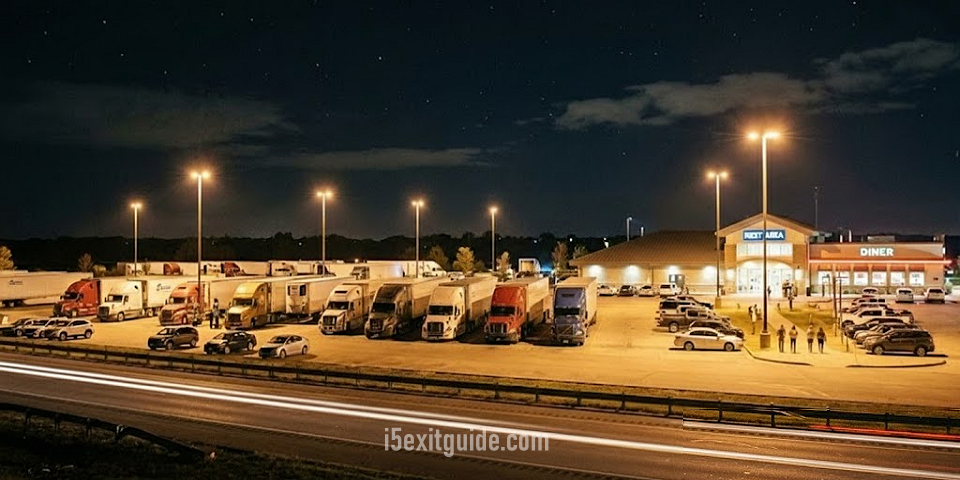
Most I-5 rest areas provide essential services: restrooms, potable water, vending machines, and often pet relief areas. Some modernized “Safety Rest Areas” also include picnic tables and traveler information kiosks, making them a one-stop shop for basic human needs during a long journey.
Disadvantages of Overnight Parking in I-5 Rest Areas
1. Security and Crime Concerns
Rest areas can be isolated, especially in rural stretches of Northern California or Southern Oregon. While many are patrolled by state police, they are public spaces that can attract illicit activity. The lack of controlled access (unlike a gated campground) means travelers must remain vigilant regarding their personal safety and the security of their belongings.
2. Environmental Factors: Noise and Light
Rest areas are rarely quiet. The constant drone of highway traffic, combined with the idling engines of refrigerated semi-trucks (reefers), can make deep sleep difficult. Furthermore, high-intensity security lighting, while good for safety, can be intrusive for those sleeping in passenger vehicles or vans without blackout curtains.
3. Limited Facilities
Unlike “truck stops” (e.g., Love’s or Flying J) or RV parks, state-run rest areas do not offer showers, laundry facilities, or electrical hookups. For those traveling in electric vehicles or RVs needing power, a rest area is strictly a “dry camping” or “boondocking” experience.
4. Legal Ambiguity and Enforcement
The most significant disadvantage is the legal “gray area” regarding time limits. While states allow “resting,” they strictly prohibit “camping.” If a traveler stays too long or sets up external gear (like chairs or grills), they risk citations or being asked to move by law enforcement in the middle of the night.
State Laws and Statutes Along the I-5 Corridor
The legality of overnight parking is determined by individual state Departments of Transportation (DOT) and state legislatures. Below is the legal breakdown for the three states comprising the I-5 corridor.
Washington State
Washington is known for having a relatively strict but clear policy regarding rest area usage. The state views rest areas as safety tools, not destinations.
- The Law: Revised Code of Washington (RCW) 47.38.020
- Time Limit: 8 Hours.
- Statutory Language: The law grants the Washington State Department of Transportation (WSDOT) the authority to “adopt rules… governing the use and control of rest areas.” Under WSDOT policy and WAC 468-32, parking is limited to a maximum of eight hours in any 24-hour period.
- Camping Prohibition: RCW 47.38.020(2) explicitly states: “It is unlawful for any person to erect any structure… or to camp, except in areas designated by the department.”
- Nuance: In Washington, “camping” is defined as the use of a rest area for personal habitation, such as pitching a tent, or staying beyond the 8-hour limit. However, sleeping in a vehicle for the duration of the 8-hour window to avoid driver fatigue is generally permitted and encouraged.
Oregon
Oregon offers the most generous time limits on the I-5 corridor, reflecting the state’s emphasis on driver safety over long distances.
- The Law: Oregon Revised Statute (ORS) 366.490 and Oregon Administrative Rule (OAR) 734-030-0010
- Time Limit: 12 Hours.
- Statutory Language: ORS 366.490 authorizes the Oregon Department of Transportation (ODOT) to establish rules for rest areas. OAR 734-030-0010 specifies: “A person may not park a vehicle or remain at a rest area for more than 12 hours within any 24-hour period.”
- Camping Prohibition: Oregon is strict about the “No Camping” rule. OAR 734-030-0010 prohibits “camping,” which includes the setup of tents, heaters, wood fires, or any activity that suggests a permanent or semi-permanent stay.
- Nuance: Oregon law specifically notes that the 12-hour limit is intended to provide “emergency rest” for motorists. This makes Oregon a favorite for long-haul travelers who need a full night’s sleep (8–10 hours) without the pressure of an expiring 8-hour clock.
California
California’s regulations are governed by the California Vehicle Code and the California Department of Transportation (Caltrans) policies. Due to the state’s large population and issues with homelessness, enforcement can be more rigorous in urban areas.
- The Law: California Vehicle Code (CVC) Section 22520.6
- Time Limit: 8 Hours.
- Statutory Language: CVC 22520.6 makes it a violation to park or leave a vehicle standing in a rest area for more than the time period posted by signs. While the statute gives Caltrans the power to set limits, the standard posted limit across the I-5 corridor is 8 hours.
- Camping Prohibition: California Code of Regulations (CCR) Title 21, Division 2, Chapter 20 prohibits camping in rest areas. Specifically, Section 2205 states: “No person shall camp, pitch a tent, or use a camp stove or other device for cooking in a safety roadside rest area.”
- Nuance: California law focuses heavily on the “emergency” nature of rest. While you can sleep in your car to avoid fatigue, if you are observed performing “housekeeping” activities (hanging laundry, cooking outside), you will likely be cited under CVC 22520.6. Additionally, some rest areas in high-traffic zones may have shorter limits or increased California Highway Patrol (CHP) presence to ensure turnover.
Best Practices for Overnighting on I-5
To maximize the advantages and minimize the legal risks of using I-5 rest areas, travelers should adhere to the following “unwritten rules” of the road:
- Observe the “Slide-In” Rule: Do not extend slide-outs on RVs or pop-up campers. This is a clear signal of “camping” rather than “resting” and takes up excessive space in lots often crowded with semi-trucks.
- Stay Inside the Vehicle: Keep all activity contained within the vehicle. Do not set up lawn chairs, grills, or external generators.
- Respect the Truckers: I-5 is a commercial lifeline. The oversized parking spots are for semi-trucks that are legally required by the Federal Motor Carrier Safety Administration (FMCSA) to take rest breaks. If you are in a passenger car or small van, use the designated “auto” parking sections to leave the large spots for those who have no other options.
- Check for “Closed” Signs: Particularly in California and Oregon, rest areas frequently close for maintenance or due to staffing shortages. Use apps like “Trucker Path” or state-specific DOT websites (e.g., WSDOT Real-Time Map) to verify a rest area is open before banking your night’s sleep on it.
- Leave No Trace: Rest areas are under-funded. Dispose of trash in designated bins and never dump gray or black water tanks in the toilets or on the ground. This behavior is the primary reason rest areas are closed or time limits are shortened.
Conclusion
Overnight parking at I-5 rest areas is a vital utility for the safety and economy of the West Coast. The advantages—primarily fatigue mitigation and cost savings—far outweigh the disadvantages of noise and limited amenities, provided the traveler is prepared. However, the legality of the stay hinges on a delicate distinction: rest areas are for resting, not for vacationing.
Washington and California strictly enforce an 8-hour limit, while Oregon provides a more lenient 12-hour window. In all three states, the statutes (RCW 47.38.020, ORS 366.490, and CVC 22520.6) converge on a single principle: these spaces must remain available for all motorists to combat exhaustion. By respecting these time limits and avoiding the outward appearance of “camping,” travelers can safely and legally navigate the I-5 corridor, ensuring they reach their destination alert and unharmed. As the “van life” movement and nomadic travel continue to grow, the preservation of these spaces depends entirely on the responsible adherence of the public to these state-mandated rules.
Disclaimer: This information is for general guidance only and does not constitute legal advice. Laws and time limits at I-5 rest areas are subject to change without notice. Always verify rules via official state DOT websites and obey all posted signage. The author assumes no liability for fines, towing, or safety issues resulting from the use of this guide. Rest at your own risk.
The I-5 Exit Guide is the Internet’s largest and most complete website dedicated to Interstate 5 travelers. Find detailed exit service listings… lodging, camping, food, gas and more for every exit from Washington to California!
On the road? Why not take us with you. The I-5 Exit Guide is mobile-friendly and totally FREE. No App Required.
Traveling another route? Visit our growing family of exit guides: I-4 Exit Guide, I-5 Exit Guide, I-10 Exit Guide, I-75 Exit Guide, I-80 Exit Guide and I-95 Exit Guide. Detailed exit service listings… discount lodging, camping, food, gas and more for every exit along the way!